Stablecoin sandwich: How it works in cross-border payments

Cross-border payments can be slow and operationally complex. Depending on the payment corridor, you may need to:
- Work around bank cut-off times
- Prefund accounts in multiple markets
- Rely on several intermediaries
- Wait anywhere from a few hours to several days for funds to arrive
A stablecoin sandwich offers another way to structure these payments. The payment starts in fiat, uses a stablecoin for the cross-border leg, then converts back into fiat before reaching the recipient. In many cases, the sender and recipient can continue using familiar fiat currencies, while the stablecoin operates behind the scenes.
Stablecoins often move value more quickly than traditional cross-border infrastructure. The on-chain portion can settle in seconds, although the full fiat-to-fiat journey can still take longer depending on the infrastructure at either end.
That means the value of a stablecoin sandwich depends heavily on the infrastructure around the stablecoin transfer. The fiat and digital asset layers both affect how quickly and efficiently the full payment can move.
In this guide, we’ll cover:
- What is a stablecoin sandwich?
- How does a stablecoin sandwich work? Step-by-step example
- How does a stablecoin sandwich improve cross-border payments?
- Who can use a stablecoin sandwich?
- What do you need to implement a stablecoin sandwich?
- How ClearBank supports stablecoin-enabled cross-border payments
- How Orbital uses ClearBank to connect stablecoins with fast euro settlement
ClearBank is a regulated B2B bank with banking licences in the UK and EU. If you’re exploring stablecoin sandwich payments, our Digital Asset Rails can connect the on-chain transfer to established fiat banking infrastructure at both ends. Get in touch to learn more.
What is a stablecoin sandwich?
Stablecoins are digital assets designed to maintain a stable value by being pegged to another asset, usually a fiat currency such as the euro or US dollar. Fiat-backed stablecoins such as EURC or USDC are intended to reduce the price volatility associated with unbacked cryptocurrencies.
A stablecoin sandwich is a cross-border payment model in which a stablecoin serves as the settlement layer between two fiat transactions. The “sandwich” metaphor describes the three stages of the payment:
- The first slice of bread is the fiat on-ramp. The payment starts in a traditional currency, such as euros, which is converted into a stablecoin.
- The filling is the on-chain stablecoin transfer. The stablecoin moves over a blockchain to the destination side of the transaction.
- The second slice of bread is the fiat off-ramp. The stablecoin is redeemed back into fiat and paid out to the recipient in that currency or converted to their local currency.
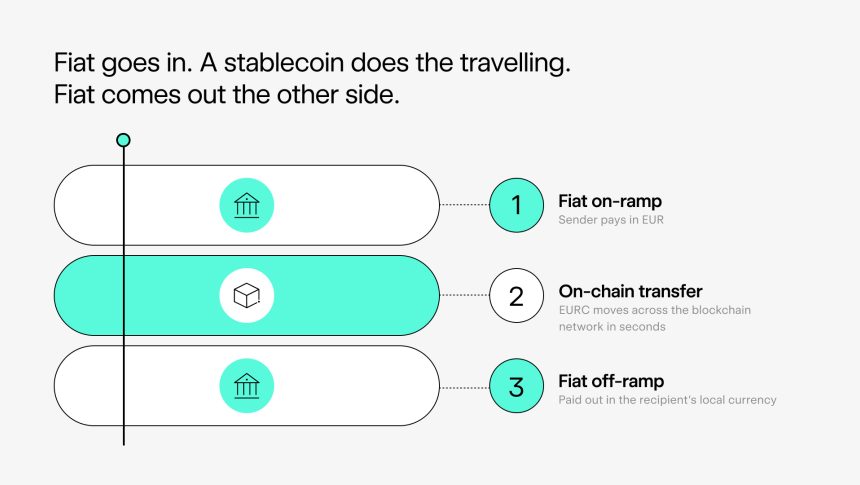
This model is also sometimes referred to as a full stablecoin sandwich.
In an “open” or “half” sandwich, one side keeps the funds in stablecoins rather than immediately converting them back into fiat. This can make sense when the recipient already uses stablecoins for payments, treasury, or further on-chain transactions and doesn’t need to off-ramp straight away.
How does a stablecoin sandwich work? Step-by-step example
Let’s say you’re a business in Europe that wants to send money to a recipient in another market. Instead of routing the full payment through a traditional correspondent banking chain, you can use a stablecoin to move value across the middle of the transaction.
Here’s how your payment could work:
- You fund the payment in fiat. You send money, such as euros, from your bank account to the provider handling the fiat on-ramp.
- The fiat is converted into a stablecoin. The provider converts your funds into a fiat-backed stablecoin, such as EURC. Depending on the setup, this may involve using existing stablecoins or minting new ones, in which the issuer creates new tokens in exchange for an equivalent amount of fiat.
- The stablecoin moves over the blockchain. The stablecoin is transferred to the destination side of the payment. This on-chain leg can settle in seconds and operate outside conventional banking hours.
- The stablecoin is converted back into fiat. At the destination, the stablecoin is redeemed or exchanged for the currency your recipient wants. If it’s redeemed through the issuer, the stablecoins are “burned,” meaning the tokens are permanently removed from circulation as the equivalent fiat is returned.
- Your recipient receives the funds through a local payment rail. The fiat is paid into their bank account using the relevant domestic or regional payment infrastructure.
For you and your recipient, the experience can remain largely fiat-based. The stablecoin operates as the settlement layer in the middle, rather than something either party necessarily needs to hold or manage.
Who provides each part of a stablecoin sandwich?
Even when the on-chain transfer settles within seconds or minutes, other parts of the stablecoin sandwich can affect the overall payment speed. That’s why it helps to understand which providers and infrastructure sit at each stage.
Banking and payment rails
Move fiat into the payment at the start and deliver fiat to the recipient at the end.
Stablecoin issuer
Issues and redeems the fiat-backed stablecoin used to move value between the two sides of the transaction.
Wallet infrastructure
Provides the wallets for securely holding and transferring stablecoins.
Blockchain network
Records and settles the on-chain stablecoin transfer.
Liquidity and FX infrastructure
Provides the currencies and liquidity needed to convert between fiat and stablecoins, and between different fiat currencies where required.
Compliance infrastructure
Supports controls such as KYC, AML, sanctions screening, Travel Rule compliance, and transaction monitoring as value moves between fiat and digital asset environments.
How does a stablecoin sandwich improve cross-border payments?
The main advantage of a stablecoin sandwich is that it can remove some of the delays and liquidity constraints associated with traditional cross-border payment routes. Where those benefits are strongest depends on the corridor and the infrastructure at either end.
Move money outside traditional banking windows
Stablecoins can move 24/7, including at times when some traditional payment or FX infrastructure may be unavailable.
For a cross-border payment, this means you don’t necessarily have to wait for the next banking day before moving value between markets. This can be particularly useful if you operate internationally or manage payment flows across different time zones.
However, the stablecoin is only the middle of the sandwich. The full payment can still be delayed by the fiat infrastructure at either end, so the availability of the on- and off-ramps and final payout rail still affects how quickly the transaction completes.
Reduce prefunding and move liquidity when it’s needed
Traditional cross-border payment models can require you to keep funds available across multiple markets, so payments can be settled when customers or counterparties need them.
A stablecoin sandwich gives you another way to move that liquidity. Instead of holding as much money in destination accounts in anticipation of future payments, you may be able to transfer value on-chain when funding is needed.
For treasury teams, this can mean less operational liquidity sitting idle across multiple markets and more control over when and where funds are deployed. It can be especially useful when you need to move funds between markets outside traditional banking hours.
Reduce intermediary chains in less efficient payment corridors
Traditional international payments can pass through several correspondent banks before reaching the recipient, particularly when the sender’s and recipient’s banks don’t have a direct relationship.
By using a stablecoin in the middle leg of the journey, you may be able to reduce the number of intermediaries involved and make settlement faster and more predictable.
This can be helpful when the existing cross-border route is slow, expensive, or operationally cumbersome.
Note: Where fast, low-cost fiat rails already work well, adding stablecoin conversion may create extra complexity without much added benefit.
Who can use a stablecoin sandwich?
Stablecoin sandwiches can suit regulated digital asset businesses and more traditional regulated financial institutions. Banks, EMIs, payment institutions, and fintechs are also exploring stablecoins as a settlement or treasury tool rather than a direct payment option. This means you can explore stablecoin infrastructure without necessarily turning your customer-facing proposition into a digital asset product.
In practice, you might use both traditional and stablecoin-based payment routes depending on the corridor. The key is identifying where using a stablecoin for the middle of the transaction removes enough friction to justify the additional conversion steps.
What do you need to implement a stablecoin sandwich?
Implementing a stablecoin sandwich means ensuring the infrastructure supporting the on-chain transfer can handle the full payment. Even if the stablecoin moves in seconds, problems elsewhere in the flow can still introduce delays or additional costs. As such, look for:
- Reliable on- and off-ramps and sufficient liquidity. You need to move efficiently between fiat and stablecoins at both ends of the transaction. If FX is involved, the availability and cost of liquidity in each currency will also affect whether the route makes commercial sense.
- Secure digital asset infrastructure. Institutional wallet infrastructure and a supported blockchain are needed to hold and transfer the stablecoin securely. For regulated firms, that infrastructure also needs to meet appropriate standards for resilience, governance, and access controls.
- Controls that cover the full payment journey. Using a stablecoin doesn’t eliminate the compliance requirements associated with the underlying payment. Customer due diligence, transaction monitoring, sanctions controls, and traceability still need to work as value moves between fiat and on-chain environments.
Where several providers handle different parts of the transaction, you’ll also need to confirm where each party’s responsibilities begin and end. The more fragmented these layers are, the more integrations and handoffs you may need to manage.
How ClearBank supports stablecoin-enabled cross-border payments
ClearBank is a regulated B2B bank built on cloud-native, API-first infrastructure that provides banking and payments infrastructure across the UK and Europe. Through our Digital Asset Rails, regulated institutions can connect stablecoin transfers to fiat settlement, helping reduce the fragmentation that often surrounds stablecoin payment flows.
We were the first Dutch credit institution to receive authorisation from the AFM to provide specified crypto asset services as a Crypto Asset Service Provider (CASP). Our proposition focuses on the integration of MiCA-regulated stablecoins, including Circle’s EURC, rather than broader crypto or digital assets trading.
Connect fiat and stablecoin infrastructure through one regulated ecosystem to reduce provider fragmentation
A stablecoin sandwich can become complicated when you need one provider for fiat accounts and payment rails, another for stablecoin minting and redemption, and additional relationships to manage wallets and on-chain transfers.
ClearBank’s Digital Asset Rails bring more of those components together. In Europe, we connect our existing banking and payment infrastructure to Circle-issued stablecoins, while Taurus provides the institutional wallet infrastructure that supports our stablecoin-related services.
You can access these capabilities through ClearBank’s existing infrastructure rather than building a separate blockchain integration from scratch. This reduces the number of providers and handoffs you need to manage as value moves between fiat and digital asset environments.
Move value 24/7 while settling back into fiat through established payment rails
Our Digital Asset Rails in Europe use EURC as a transport layer, allowing value to move on-chain before being converted back into euros for fiat settlement. You can then use ClearBank’s established payment infrastructure for the fiat leg.
In Europe, we support SEPA Credit Transfer and SEPA Instant, alongside T2, giving you access to the rails you choose for instant and high-value euro payments. Because these sit alongside our broader accounts and payment connectivity, you can connect the stablecoin leg to the same banking infrastructure you use to manage your fiat flows.
Our infrastructure is built to help the fiat leg keep pace with an always-on stablecoin transfer:
- 24/7 SEPA Instant processing: Move euro payments outside conventional banking hours.
- Two-to-three-second SEPA Instant processing: Support end-to-end payments within the scheme’s 10-second requirement.
- 99.9% API uptime and real-time notifications: Get reliable connectivity and quicker visibility into payment status for reconciliation and liquidity management.
A fast on-chain transfer doesn’t guarantee a fast end-to-end payment. If the stablecoin leg settles in seconds but the fiat payout is delayed by limited operating hours or slow processing, much of the speed advantage is lost.
But by connecting digital asset infrastructure with cloud-native, API-driven fiat rails, you can make the full payment flow more responsive, not just the blockchain leg. For your customers or counterparties, the outcome can still remain fiat-based: the stablecoin moves value in the middle, while the final payment reaches the recipient in familiar currency through existing banking infrastructure.
How Orbital uses ClearBank to connect stablecoins with fast euro settlement
Orbital is a cross-border payments platform that connects stablecoins with traditional payment rails. Before partnering with ClearBank Europe, one of the challenges it identified in the market was that firms often had to piece together separate providers for bank transfers, stablecoins, FX, and local payment methods.
Through ClearBank Europe, Orbital gained access to real-time euro clearing, named IBANs, and SEPA infrastructure alongside its existing stablecoin capabilities.
“We selected ClearBank Europe because of its real-time clearing capabilities, market-leading API, and banking-grade compliance standards. It is simply the best embedded banking provider in Europe and has a strong track record working with digital asset platforms.”
- Chris Mason, CEO, Orbital Group
The partnership is a useful example of the wider principle behind a stablecoin sandwich: the on-chain leg can move quickly, but the overall payment only works efficiently when the fiat infrastructure around it can keep up.
Build more flexible cross-border payment flows with ClearBank’s digital asset rail infrastructure
Stablecoin sandwiches give you another way to move value across borders by combining fiat payments with an on-chain settlement layer. But the benefits depend on the infrastructure around the stablecoin transfer, including how quickly money can move into and out of fiat at either end.
At ClearBank, our Digital Asset Rails connect regulated stablecoin infrastructure to established banking and payment rails, enabling you to use stablecoins for cross-border flows without having to build every part of the stack yourself. ClearBank Europe itself does not issue or custody stablecoins; issuance and redemption are performed by Circle.
To learn more about how ClearBank can support your stablecoin sandwich model, get in touch.
FAQs
The blockchain rails in a stablecoin sandwich can move value in seconds, but the full transaction may take longer because the fiat on- and off-ramps still need to be completed. Foreign exchange, compliance checks, liquidity availability, and the speed of the final payment rail can all affect the end-to-end journey.
This is why the infrastructure around the stablecoin transfer is so important. ClearBank’s cloud-native, API-first infrastructure helps the fiat leg keep pace with the on-chain transfer. For example, we process SEPA Instant payments in around two to three seconds and support 24/7 processing, helping reduce delays when funds move back into fiat. However, the end-to-end timing still depends on the full payment chain.
Faster movement of funds can also support treasury management by giving firms more control over liquidity and working capital rather than waiting for conventional banking windows.
No. In a full stablecoin sandwich, neither party necessarily needs to hold or manage a stablecoin themselves.
For example, a sender could pay in euros, the provider could move value using blockchain technology, and the recipient could receive Brazilian reais (BRL) in their bank account. The digital currency operates in the middle of the transaction while the customer experience remains fiat-based.
Different providers may support different stablecoins, including USDC, EURC, and USDT. The stablecoin and route you choose can affect liquidity, conversion costs, regulatory requirements, and the currencies available at either end.
An open sandwich, sometimes called a half sandwich, is a payment where only one side converts between fiat and stablecoins.
For example, a business might convert euros into a stablecoin and transfer it on-chain, while the recipient keeps the funds in stablecoins rather than immediately converting them back to fiat. This can make sense when the recipient already uses stablecoins for payments, treasury management, or other blockchain-based activity.
Depending on the infrastructure involved, smart contracts can also be used to automate certain on-chain actions. However, smart contracts aren’t required for a stablecoin sandwich to work.
Yes. Banks, Electronic Money Institutions (EMIs), payment institutions, and other regulated firms can use stablecoin sandwiches as back-end payment or settlement infrastructure while continuing to offer customers a fiat-based experience.
For regulated firms, the main challenge is usually connecting the on-chain leg with suitable banking infrastructure, liquidity, compliance controls, and payment rails.
ClearBank’s Digital Asset Rails are designed for this type of use case. We connect regulated stablecoin infrastructure to our existing banking and payment rails, helping firms move between fiat and stablecoins without assembling the entire payment flow across separate providers.
A stablecoin sandwich isn’t exempt from financial regulation simply because part of the transaction uses a blockchain. Firms still need to consider stablecoin regulation, payment services requirements, anti-money laundering requirements, sanctions controls, transaction monitoring, the EU Transfer of Funds Regulation and Travel Rule and the rules that apply to fiat payments at either end.
The regulatory framework also depends on the jurisdiction. In Europe, MiCAR establishes rules for crypto-assets and regulated stablecoins. In the US, the GENIUS Act introduced a federal framework for payment stablecoins, although the precise requirements and implementation position should be assessed for the relevant activity.
ClearBank Europe is authorised as a CASP under MiCA to offer digital asset services and focuses its proposition on regulated stablecoins. This gives regulated firms a bank-led route into stablecoin payments while retaining established compliance and banking infrastructure around the transaction.